Tutorial (HCM)
In this section, we use APLUS to evaluate a Hypertrophic Cardiomyopathy (HCM) workflow.
The full .ipynb notebook for this tutorial can be found at this link.
🏥 Clinical Motivation
The goal of this project is to evaluate the clinical, resource utilization, financial, and ethical impact of possible deployment of a Hypertrophic Cardiomyopathy (HCM) ML detection model.
🤖 ML Models
We consider an ML model that combines ECG and Echo screening to detect HCM.
👩⚕️ Workflows
We were given four possible HCM workflows to consider.
We also considered two baseline workflows. The first is the optimistic workflow, where all patients are referred to the specialist without any sort of screening or capacity constraints.

The second is the random workflow, where patient’s are randomly referred to the specialist.

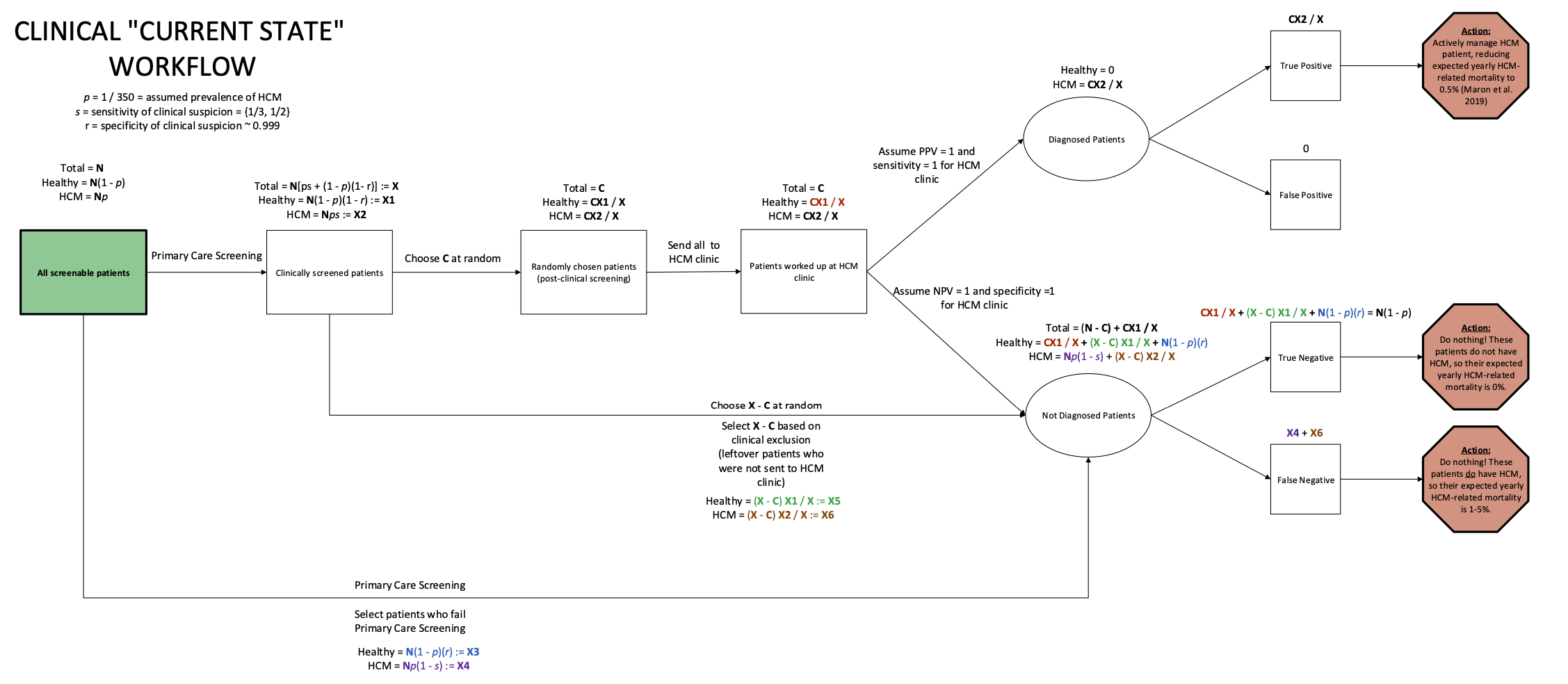
First, we considered the current state of HCM care, where patients are referred to the specialist by a primary care physician.
Next, we considered an AI-guided workflow, where the patient’s EHR is reviewed by an AI to determine if they are a candidate for HCM workup.

🔧 Creating the APLUS Config
Let’s now create our config files, one for each workflow.
We’ll start with the optimistic workflow, then the random workflow, then the current state workflow, and finally the AI-guided workflow.
For each workflow, we’ll start by defining all of the steps in the workflow as states in our YAML file. We’ll then add any variables needed for the workflow, then show the full config file at the bottom.
1. Current Workflow
For reference, here is the current state workflow that we’re trying to replicate in APLUS:
We’ll start by defining all of the steps in the workflow as states in our YAML file.
Our first state is called “All screenable patients” (in green), which is just our start state. Let’s add this state to our YAML file.
states:
  start:
    type: start
    label: "Start"
    transitions:
      - dest: prescreen_patients
It will immediately transition to the “Clinically screened patients” state, which performs a clinical screening of the patient’s EHR.
states:
  # ... existing states ...
  prescreen_patients: # Clinical pre-screened patients
    label: "Clinical screened patients"
    transitions:
      - dest: screen_patients
        if: (has_hcm and (clinical_result <=  clinical_sensitivity)) or (not has_hcm and (clinical_result >= clinical_specificity))
      - dest: undiagnosed
These patients will either be sent to the “Not Diagnosed Patients” state (if they do not have HCM), or will be sent to the a queue that randomly selects patients to be screened by the HCM clinic.
Note that has_hcm is a variable of type property that we’ll need to set for each patient in our simulation. It will be TRUE if the patient has HCM, and FALSE otherwise.
Similarly, clinical_result is another variable of type property that will be set uniformly for each patient to a random number between 0 and 1, representing the result of the clinical screening.
Finally, clinical_sensitivity and clinical_specificity are scalar variables that will be set to the sensitivity and specificity of the clinical screening, respectively. These are fixed constants that are shared across all patients.
states:
  # ... existing states ...
  screen_patients:
    label: "Screened patients"
    transitions:
      - dest: visit_hcm_clinic
        if: hcm_clinic_capacity > 0
        resource_deltas: # Decrement the capacity of the HCM clinic when a patient is seen
          hcm_clinic_capacity: -1
      - dest: undiagnosed
This state will arbitrarily send the first hcm_clinic_capacity patients to the HCM clinic, and the rest to the “Not Diagnosed Patients” state.
We will define the hcm_clinic_capacity variable later as a resource that is decremented each time a patient is seen at the HCM clinic, and refreshed at the end of each day.
For patients that make it to the HCM clinic, they are split into two groups: Diagnosed and Not Diagnosed.
We’ll assume that this split is done perfectly by the HCM clinic, i.e. all patients with HCM (as marked by a patient-level property has_hcm) are diagnosed and all patients without HCM are undiagnosed.
states:
  # ... existing states ...
  visit_hcm_clinic:
    label: "Patients worked up at HCM clinic"
    transitions:
      - dest: diagnosed
        if: has_hcm
      - dest: undiagnosed
Next, we create states for the diagnosed / undiagnosed patients.
states:
  # ... existing states ...
  diagnosed:
    label: "Diagnosed"
    transitions:
      - dest: untreated
  undiagnosed:
    label: "Undiagnosed"
    transitions:
      - dest: untreated
Finally, we create end states for each of the four possible outcomes (True Positive, False Positive, True Negative, False Negative) and assign utility values to each.
- Our main utility is the 5-yr risk of HCM-related death for each patient. We’ll assume the following mortality rates:
True Positives: Annual mortality = 0.5%
Delayed True Positives (for AI-guided workflow): Annual mortality = 5% the first year, 0.5% thereafter
False Negatives: Annual mortality = 5%
True Negatives: Annual mortality = 0%
False Positives: Annual mortality = 0%
states:
  # ... existing states ...
  true_positive:
    type: end
    label: "True Positive"
    utilities:
      - value: 0.995**5 # 0.5% annual ortality for 5 years
        unit: five_year_life_expectancy
  false_positive:
    type: end
    label: "False Positive"
    utilities:
      - value: 1
        unit: five_year_life_expectancy
  true_negative:
    type: end
    label: "True Negative"
    utilities:
      - value: 1
        unit: five_year_life_expectancy
  false_negative:
    type: end
    label: "False Negative"
    utilities:
      - value: 0.95**5 # 5% annual mortality for 5 years
        unit: five_year_life_expectancy
Let’s finish this config by adding relevant variables to the config.
We’ll assume the HCM clinic can see 2 patients per day, and that the clinical screening has 95% sensitivity and specificity.
variables:

variables:
  # Patient properties
  has_hcm:
    type: property # Boolean property that is true if the patient has HCM
    value: None # this will be overwritten by our Python script
  clinical_result: # Used for determining if the patient is positive for clinical screening
    type: property
    distribution: uniform
    start: 0
    end: 1
  # Fixed constants
  clinical_sensitivity:
    value: 0.95 # Sensitivity of clinical screening ('s' in the diagram)
  clinical_specificity:
    value: 0.95 # Specificity of clinical screening ('r' in the diagram)
  # Resources
  hcm_clinic_capacity:
    type: resource
    init_amount: 2
    max_amount: 2 # HCM clinic can only see 2 patients per day ('C' in the diagram)
    refill_amount: 2
    refill_duration: 1 # Resets every day
Our final config is shown below.
metadata:
  name: "HCM (Base for random / current / optimistic)"

variables:
  # Patient properties
  has_hcm:
    type: property # Boolean property that is true if the patient has HCM
    value: None # this will be overwritten
  clinical_result:
    type: property
    distribution: uniform
    start: 0
    end: 1
  # Fixed constants
  clinical_sensitivity:
    value: 0.95 # Sensitivity of clinical screening ('s' in the diagram)
  clinical_specificity:
    value: 0.95 # Specificity of clinical screening ('r' in the diagram)
  # Resources
  hcm_clinic_capacity:
    type: resource
    init_amount: 2
    max_amount: 2 # HCM clinic can only see 2 patients per day ('C' in the diagram)
    refill_amount: 2
    refill_duration: 1 # Resets every day

states:
  start:
    type: start
    label: "Start"
    transitions:
      - dest: prescreen_patients
  prescreen_patients: # Clinical pre-screening
    label: "Clinical screening"
    transitions:
      - dest: screen_patients
        if: (has_hcm and (clinical_result <=  clinical_sensitivity)) or (not has_hcm and (clinical_result >= clinical_specificity))
      - dest: undiagnosed
  screen_patients:
    label: "Screened patients"
    transitions:
      - dest: visit_hcm_clinic
        if: hcm_clinic_capacity > 0
        resource_deltas: # Decrement the capacity of the HCM clinic when a patient is seen
          hcm_clinic_capacity: -1
      - dest: undiagnosed
  visit_hcm_clinic:
    label: "Patients worked up at HCM clinic"
    transitions:
      - dest: diagnosed
        if: has_hcm
      - dest: undiagnosed
  diagnosed:
    label: "Diagnosed"
    transitions:
      - dest: true_positive
        if: has_hcm
      - dest: false_positive
        if: not has_hcm
  undiagnosed:
    label: "Undiagnosed"
    transitions:
      - dest: true_negative
        if: not has_hcm
      - dest: false_negative
  true_positive:
    type: end
    label: "True Positive"
    utilities:
      - value: 0.995**5 # 0.5% annual ortality for 5 years
        unit: five_year_life_expectancy
  false_positive:
    type: end
    label: "False Positive"
    utilities:
      - value: 1
        unit: five_year_life_expectancy
  true_negative:
    type: end
    label: "True Negative"
    utilities:
      - value: 1
        unit: five_year_life_expectancy
  false_negative:
    type: end
    label: "False Negative"
    utilities:
      - value: 0.95**5 # 5% annual mortality for 5 years
        unit: five_year_life_expectancy
2. Random Workflow
For reference, here is the random workflow that we’re trying to replicate in APLUS:
This workflow is identical to the current state workflow, with these minor adjustments:
Change the
startstate to transition to thescreen_patientsstateDelete the
prescreen_patientsstate
3. Optimistic Workflow
For reference, here is the optimistic workflow that we’re trying to replicate in APLUS:
This workflow is identical to the current state workflow, with these minor adjustments:
Change the
startstate to transition to thevisit_hcm_clinicstateDelete the
prescreen_patientsstatesDelete the
screen_patientsstates
4. AI-guided Workflow
Finally, we’re going to replicate the AI-guided workflow (shown below) in APLUS:
Let’s start by definining our start state, which will transition to the ecg_screening state.
states:
  start:
    type: start
    label: "Start"
    transitions:
      - dest: ecg_screening
Now, let’s add the ecg_screening state, which will transition to the echo_screening state.
Both of these states have a sensitivity and specificity, which we’ll later define as scalar variables.
states:
  # ... existing states ...
  ecg_screening:
    label: "ECG screening"
    transitions:
      - dest: echo_screening
        # The patient is marked as POSITIVE for ECG screen if...
        #   Has HCM + ECG result is <= the sensitivity of the ECG screening, or
        #   Does not have HCM + ECG result is >= the specificity of the ECG screening
        if: (has_hcm and (ecg_result <= ecg_sensitivity)) or (not has_hcm and (ecg_result >= ecg_specificity))
      - dest: undiagnosed
  echo_screening:
    label: "Echo screening"
    transitions:
      - dest: hcm_triage
        # The patient is marked as POSITIVE for Echo screen if...
        #   Has HCM + Echo result is <= the sensitivity of the Echo screening, or
        #   Does not have HCM + Echo result is >= the specificity of the Echo screening
        if: (has_hcm and (echo_result <= echo_sensitivity)) or (not has_hcm and (echo_result >= echo_specificity))
      - dest: undiagnosed
If the patient is flagged as POSITIVE for either of these screens, they will be sent to the hcm_triage state. This state will either…
Send the patient to the visit_hcm_clinic state if the HCM clinic has capacity (i.e. hcm_clinic_capacity > 0), or
Send the patient to the hcm_flex_waitlist state
If the patient does go to the HCM clinic, we’ll decrement the hcm_clinic_capacity resource by 1.
states:
  # ... existing states ...
  hcm_triage:
    label: "HCM triage"
    transitions:
      - dest: visit_hcm_clinic
        if: hcm_clinic_capacity > 0
        resource_deltas: # Decrement the capacity of the HCM clinic when a patient is seen
          hcm_clinic_capacity: -1
      - dest: hcm_flex_waitlist
If the patient makes it to the HCM clinic, they will be split into two groups: Diagnosed and Not Diagnosed. We assume the HCM clinic can perfectly diagnose patients.
states:
  # ... existing states ...
  visit_hcm_clinic:
    label: "Patients worked up at HCM clinic"
    transitions:
      - dest: diagnosed
        if: has_hcm
      - dest: undiagnosed
If the HCM clinic was initially full, the patient will be sent to the hcm_flex_waitlist state.
We will then either…
Send the patient to the
visit_hcm_clinic_delayedstate if the HCM clinic has capacity (i.e.hcm_delayed_clinic_capacity > 0), orSend the patient to the
undiagnosedstate
states:
  # ... existing states ...
  hcm_flex_waitlist:
    label: "Patients not worked up at HCM clinic with minimal delay"
    transitions:
      - dest: visit_hcm_clinic_delayed
        if: hcm_delayed_clinic_capacity > 0
        resource_deltas: # Decrement the capacity of the HCM clinic when a patient is seen
          hcm_delayed_clinic_capacity: -1
      - dest: undiagnosed
  visit_hcm_clinic_delayed:
    label: "Patients worked up at HCM clinic (delay up to 1 year)"
    transitions:
      - dest: diagnosed_delayed
        if: has_hcm # Assume perfect split between diagnosed and undiagnosed
      - dest: undiagnosed
If the patient is diagnosed immediately, they will be sent to the diagnosed state. If they end up in the visit_hcm_clinic_delayed state and have to wait up to 1 year to be diagnosed, they will be sent to the diagnosed_delayed state.
states:
  # ... existing states ...
  diagnosed_delayed:
    label: "Diagnosed (delay up to 1 year)"
    transitions:
      - dest: true_positive_delayed
  diagnosed:
    label: "Diagnosed"
    transitions:
      - dest: true_positive
        if: has_hcm
      - dest: false_positive
        if: not has_hcm
  undiagnosed:
    label: "Undiagnosed"
    transitions:
      - dest: true_negative
        if: not has_hcm
      - dest: false_negative
Finally, we copy the same utility states as from the current state workflow, but add a new true_positive_delayed state that will be used for patients who are diagnosed after a delay of up to 1 year.
These patients will have an immediate mortality risk of 5% the first year, and 0.5% thereafter.
states:
  # ... existing states ...
  true_positive_delayed:
    type: end
    label: "True Positive (delayed)"
    utilities:
      - value: 0.95 * 0.995**4 # 0.5% annual mortality for first year, 5% annual mortality for 4 years
        unit: five_year_life_expectancy
  true_positive:
    type: end
    label: "True Positive"
    utilities:
      - value: 0.995**5 # 0.5% annual ortality for 5 years
        unit: five_year_life_expectancy
  false_positive:
    type: end
    label: "False Positive"
    utilities:
      - value: 1
        unit: five_year_life_expectancy
  true_negative:
    type: end
    label: "True Negative"
    utilities:
      - value: 1
        unit: five_year_life_expectancy
  false_negative:
    type: end
    label: "False Negative"
    utilities:
      - value: 0.95**5 # 5% annual mortality for 5 years
        unit: five_year_life_expectancy
Now, let’s add the variables that we’ll need to run this workflow.
variables:
  # Patient properties
  has_hcm:
    type: property # Boolean property that is true if the patient has HCM
    value: None # this will be overwritten
  ecg_result: # Used for determining if the patient is positive for ECG screening
    type: property
    distribution: uniform
    start: 0
    end: 1
  echo_result: # Used for determining if the patient is positive for Echo screening
    type: property
    distribution: uniform
    start: 0
    end: 1
  # Fixed constants
  ecg_sensitivity:
    value: 0.95 # Sensitivity of ECG screening ('g' in the diagram)
  ecg_specificity:
    value: 0.95 # Specificity of ECG screening ('f' in the diagram)
  echo_sensitivity:
    value: 0.95 # Sensitivity of Echo screening ('h' in the diagram)
  echo_specificity:
    value: 0.95 # Specificity of Echo screening ('j' in the diagram)
  # Resources
  hcm_clinic_capacity:
    type: resource
    init_amount: 2
    max_amount: 2 # HCM clinic can only see 2 patients per day ('C' in the diagram)
    refill_amount: 2
    refill_duration: 1 # Resets every day
  hcm_delayed_clinic_capacity:
    type: resource
    init_amount: 100
    max_amount: 100 # HCM clinic can only see 100 patients in a year with delay after failing initial HCM triage, aka flex capacity ('F' in the diagram)
    refill_amount: 100
    refill_duration: 365 # Resets every year
variables:
  # Patient properties
  has_hcm:
    type: property # Boolean property that is true if the patient has HCM
    value: None # this will be overwritten
  ecg_result: # Used for determining if the patient is positive for ECG screening
    type: property
    distribution: uniform
    start: 0
    end: 1
  echo_result: # Used for determining if the patient is positive for Echo screening
    type: property
    distribution: uniform
    start: 0
    end: 1
  # Fixed constants
  ecg_sensitivity:
    value: 0.95 # Sensitivity of ECG screening ('g' in the diagram)
  ecg_specificity:
    value: 0.95 # Specificity of ECG screening ('f' in the diagram)
  echo_sensitivity:
    value: 0.95 # Sensitivity of Echo screening ('h' in the diagram)
  echo_specificity:
    value: 0.95 # Specificity of Echo screening ('j' in the diagram)
  # Resources
  hcm_clinic_capacity:
    type: resource
    init_amount: 2
    max_amount: 2 # HCM clinic can only see 2 patients per day ('C' in the diagram)
    refill_amount: 2
    refill_duration: 1 # Resets every day
  hcm_delayed_clinic_capacity:
    type: resource
    init_amount: 100
    max_amount: 100 # HCM clinic can only see 100 patients in a year with delay after failing initial HCM triage, aka flex capacity ('F' in the diagram)
    refill_amount: 100
    refill_duration: 365 # Resets every year
Putting it all together, we get the following config for the AI-guided workflow:
metadata:
  name: "HCM (AI-Guided)"

variables:
  # Patient properties
  has_hcm:
    type: property # Boolean property that is true if the patient has HCM
    value: None # this will be overwritten
  ecg_result: # Used for determining if the patient is positive for ECG screening
    type: property
    distribution: uniform
    start: 0
    end: 1
  echo_result: # Used for determining if the patient is positive for Echo screening
    type: property
    distribution: uniform
    start: 0
    end: 1
  # Fixed constants
  ecg_sensitivity:
    value: 0.95 # Sensitivity of ECG screening ('g' in the diagram)
  ecg_specificity:
    value: 0.95 # Specificity of ECG screening ('f' in the diagram)
  echo_sensitivity:
    value: 0.95 # Sensitivity of Echo screening ('h' in the diagram)
  echo_specificity:
    value: 0.95 # Specificity of Echo screening ('j' in the diagram)
  # Resources
  hcm_clinic_capacity:
    type: resource
    init_amount: 2
    max_amount: 2 # HCM clinic can only see 2 patients per day ('C' in the diagram)
    refill_amount: 2
    refill_duration: 1 # Resets every day
  hcm_delayed_clinic_capacity:
    type: resource
    init_amount: 100
    max_amount: 100 # HCM clinic can only see 100 patients in a year with delay after failing initial HCM triage, aka flex capacity ('F' in the diagram)
    refill_amount: 100
    refill_duration: 365 # Resets every year

states:
  start:
    type: start
    label: "Start"
    transitions:
      - dest: ecg_screening
  ecg_screening:
    label: "ECG screening"
    transitions:
      - dest: echo_screening
        # The patient is marked as POSITIVE for ECG screen if...
        #   Has HCM + ECG result is <= the sensitivity of the ECG screening, or
        #   Does not have HCM + ECG result is >= the specificity of the ECG screening
        if: (has_hcm and (ecg_result <= ecg_sensitivity)) or (not has_hcm and (ecg_result >= ecg_specificity))
      - dest: undiagnosed
  echo_screening:
    label: "Echo screening"
    transitions:
      - dest: hcm_triage
        # The patient is marked as POSITIVE for Echo screen if...
        #   Has HCM + Echo result is <= the sensitivity of the Echo screening, or
        #   Does not have HCM + Echo result is >= the specificity of the Echo screening
        if: (has_hcm and (echo_result <= echo_sensitivity)) or (not has_hcm and (echo_result >= echo_specificity))
      - dest: undiagnosed
  hcm_triage:
    label: "HCM triage"
    transitions:
      - dest: visit_hcm_clinic
        if: hcm_clinic_capacity > 0
        resource_deltas: # Decrement the capacity of the HCM clinic when a patient is seen
          hcm_clinic_capacity: -1
      - dest: hcm_flex_waitlist
  visit_hcm_clinic:
    label: "Patients worked up at HCM clinic"
    transitions:
      - dest: diagnosed
        if: has_hcm
      - dest: undiagnosed
  hcm_flex_waitlist:
    label: "Patients not worked up at HCM clinic with minimal delay"
    transitions:
      - dest: visit_hcm_clinic_delayed
        if: hcm_delayed_clinic_capacity > 0
        resource_deltas: # Decrement the capacity of the HCM clinic when a patient is seen
          hcm_delayed_clinic_capacity: -1
      - dest: undiagnosed
  visit_hcm_clinic_delayed:
    label: "Patients worked up at HCM clinic (delay up to 1 year)"
    transitions:
      - dest: diagnosed_delayed
        if: has_hcm # Assume perfect split between diagnosed and undiagnosed
      - dest: undiagnosed
  diagnosed_delayed:
    label: "Diagnosed (delay up to 1 year)"
    transitions:
      - dest: true_positive_delayed
  diagnosed:
    label: "Diagnosed"
    transitions:
      - dest: true_positive
        if: has_hcm
      - dest: false_positive
        if: not has_hcm
  undiagnosed:
    label: "Undiagnosed"
    transitions:
      - dest: true_negative
        if: not has_hcm
      - dest: false_negative
  true_positive_delayed:
    type: end
    label: "True Positive (delayed)"
    utilities:
      - value: 0.95 * 0.995**4 # 0.5% annual mortality for first year, 5% annual mortality for 4 years
        unit: five_year_life_expectancy
  true_positive:
    type: end
    label: "True Positive"
    utilities:
      - value: 0.995**5 # 0.5% annual ortality for 5 years
        unit: five_year_life_expectancy
  false_positive:
    type: end
    label: "False Positive"
    utilities:
      - value: 1
        unit: five_year_life_expectancy
  true_negative:
    type: end
    label: "True Negative"
    utilities:
      - value: 1
        unit: five_year_life_expectancy
  false_negative:
    type: end
    label: "False Negative"
    utilities:
      - value: 0.95**5 # 5% annual mortality for 5 years
        unit: five_year_life_expectancy
📊 Run Simulation
Now, let’s run the simulation! A full example can be found in the notebook here.
First, we need to generate patients to feed through our workflows.
np.random.seed(0)

# Simulation parameters
NUM_DAYS: int = 365
MEAN_PATIENTS_PER_DAY: int = 150_000 // 365
HCM_PREVALENCE: float = 1 / 200
HCM_CLINIC_CAPACITY: int = 2

# Sample # of patients per day
num_admits_per_day = np.random.poisson(lam=MEAN_PATIENTS_PER_DAY, size=NUM_DAYS)

# Random indexes for resource prioritization
screen_idxs: List[int] = list(range(MEAN_PATIENTS_PER_DAY * NUM_DAYS * 10))
np.random.shuffle(screen_idxs)
delayed_screen_idxs: List[int] = list(range(MEAN_PATIENTS_PER_DAY * NUM_DAYS * 10))
np.random.shuffle(delayed_screen_idxs)

# Generate patients for each day
patients: List[Patient] = []
for timestep, n_patients in enumerate(num_admits_per_day):
    for x in range(n_patients):
        # Generate patient properties
        properties = {
            'has_hcm' : np.random.rand() < HCM_PREVALENCE,
        }
        patients.append(Patient(
            len(patients), # ID
            timestep, # Start timestep
            properties=properties,
        ))
print("# of patients: ", len(patients))
print("# of days: ", NUM_DAYS)
print("Mean # of patients per day: ", np.mean(num_admits_per_day))
print("HCM prevalence: ", np.mean([p.properties['has_hcm'] for p in patients]), "(expected prevalence =", HCM_PREVALENCE, ")")
Second, we initialize the simulation.
We’ll do the AI-guided workflow in this tutorial, but the other workflows are very similar and can be found in the notebook at this link.
Note that we set is_overwrite_existing_properties=False because we already manually defined the properties (e.g. has_hcm) for our patients.
# Load AI-guided workflow
ai_simulation = aplusml.Simulation.create_from_yaml(PATH_TO_AI_YAML)
# Initialize patients
patients = ai_simulation.create_patients_for_simulation(patients, random_seed=0, is_overwrite_existing_properties=False)
Third, we run the simulation on our patients.
# Run simulation
ai_patients: List[Patient] = ai_simulation.run(patients)
Finally, we can calculate how many deaths within the 5-yr horizon occurred in our simulation.
UTILITY_UNIT: str = 'five_year_life_expectancy'
ai_sum_utilities = sum([ p.get_sum_utilities(ai_simulation)[UTILITY_UNIT] for p in ai_patients ])
print(f"Predicted deaths within 5-yrs in AI-guided workflow:  {(len(ai_patients) - ai_sum_utilities):.2f}")
To see the full notebook with the other HCM workflows, please visit this link.